 tolapay
How to accept online payments in Nepal (2026): wallets, QR, banks and cards
What a software business in Nepal can actually collect through today — eSewa, Khalti, Fonepay QR, connectIPS and cards — with the numbers behind each rail and how to wire them into one checkout.
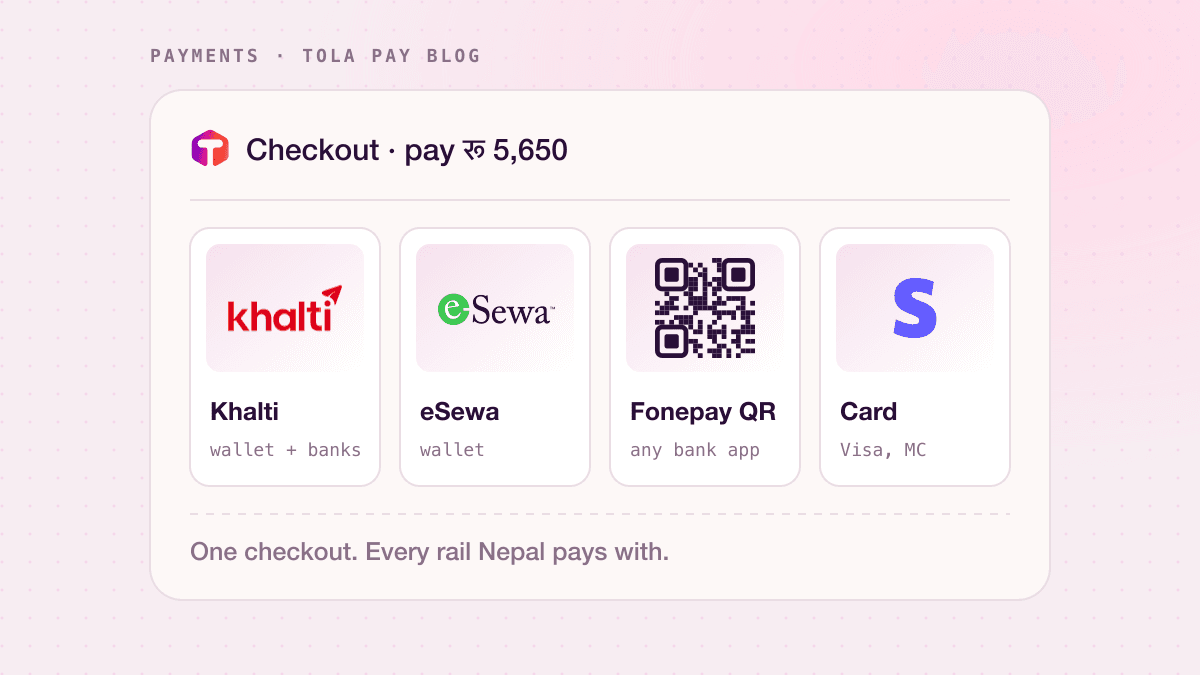
Five years ago “online payment” in Nepal meant eSewa. Today it means a stack: two large wallets, a national QR network, an interbank switch and, for a narrow slice of customers, cards. If you sell software here, you need most of them — and you need them without integrating each one by hand.
How big this has become
Nepal Rastra Bank's Payment Systems Oversight Report for FY 2024/25 puts total digital payments at about NPR 98.4 trillion, up roughly 71% in a year. QR payments alone reached about NPR 958 billion across ~316 million transactions. By mid-March 2026 NRB counted 29.5 million mobile-banking users and 27.7 million wallet users, with ~49 million QR transactions in a single month. Nobody in Nepal needs convincing to pay digitally any more; the question is whether your checkout speaks their rail.
The rails, and what each is good for
Khalti — a wallet, but more usefully a gateway: through Khalti's KPG-2 you also reach e-banking and mobile banking at every partner bank, connectIPS and SCT, from one integration. eSewa — the largest wallet (10.1 million users and 560,000 merchants in its FY 2081/82 report), with its ePay v2 redirect flow. Fonepay QR — the interoperable merchant QR most shops display; it processed a record 1,002,702 QR payments in a single day in March 2025. connectIPS — NCHL's account-to-account switch, now also carrying e-mandates for recurring debits. Cards — Visa and Mastercard through a processor such as Stripe; domestically uncommon, essential for foreign customers.
What this means for a SaaS checkout
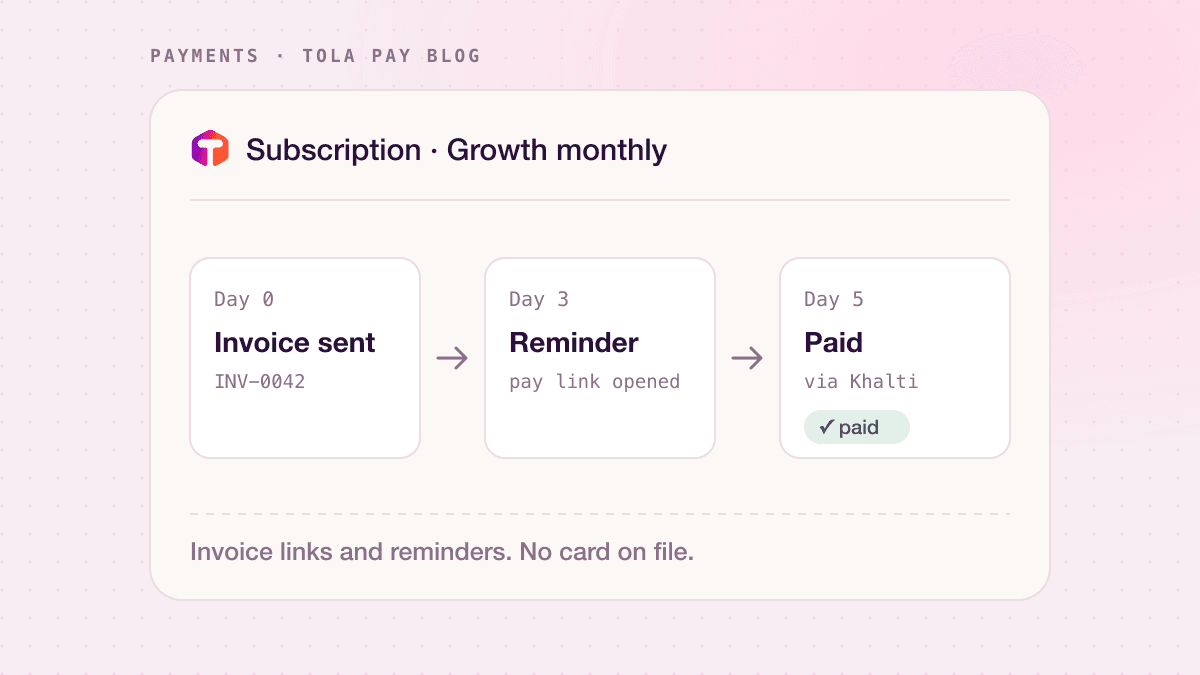
Let the customer choose. A Nepali buyer who banks with Nabil wants to tap “mobile banking → Nabil” and approve in their bank app; a freelancer wants eSewa; a company in Singapore wants a card. Tola Pay's hosted checkout shows all of them, verifies the payment server-side with the rail (Khalti lookup, eSewa status check, Stripe webhook), then marks the invoice paid and fires one `invoice.paid` webhook — whichever rail was used.
Bank transfer still matters
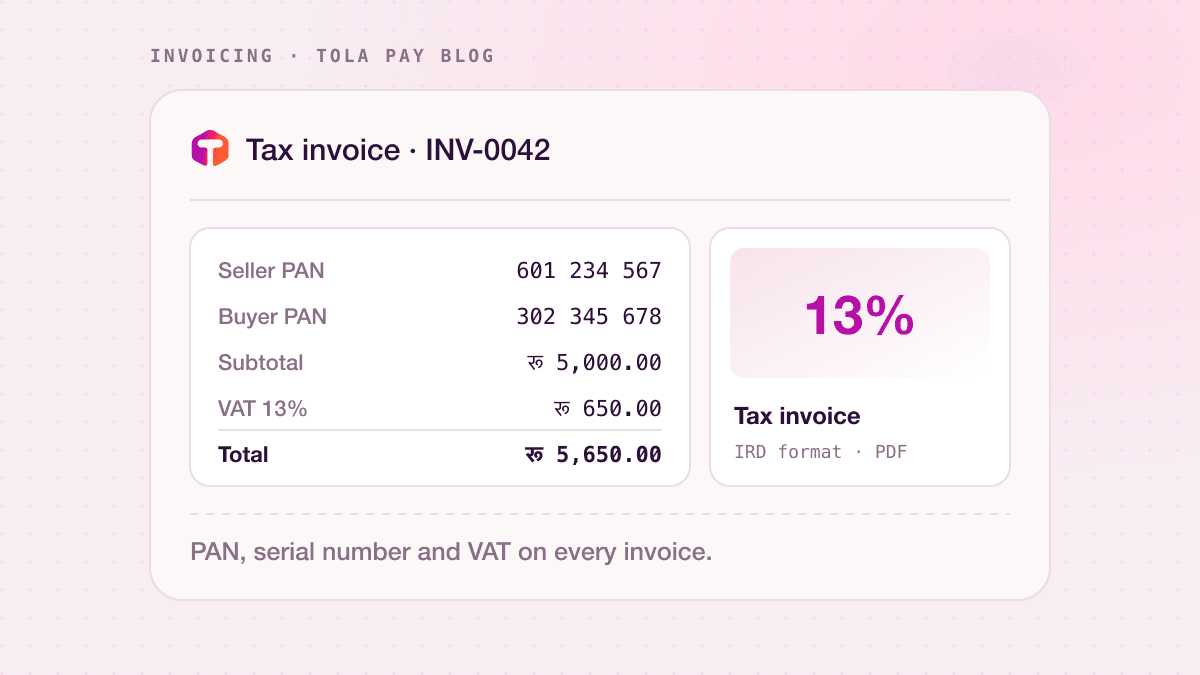
B2B customers often pay from accounts, on their own schedule. Print your bank details on the invoice PDF, give them a reference, and mark the invoice paid when the transfer lands — from the dashboard or the API. It is the least glamorous rail and, for larger invoices, the most common.
 Payments · 24 Oct 2026
 Invoicing · 21 Oct 2026
 Pricing · 15 Oct 2026